

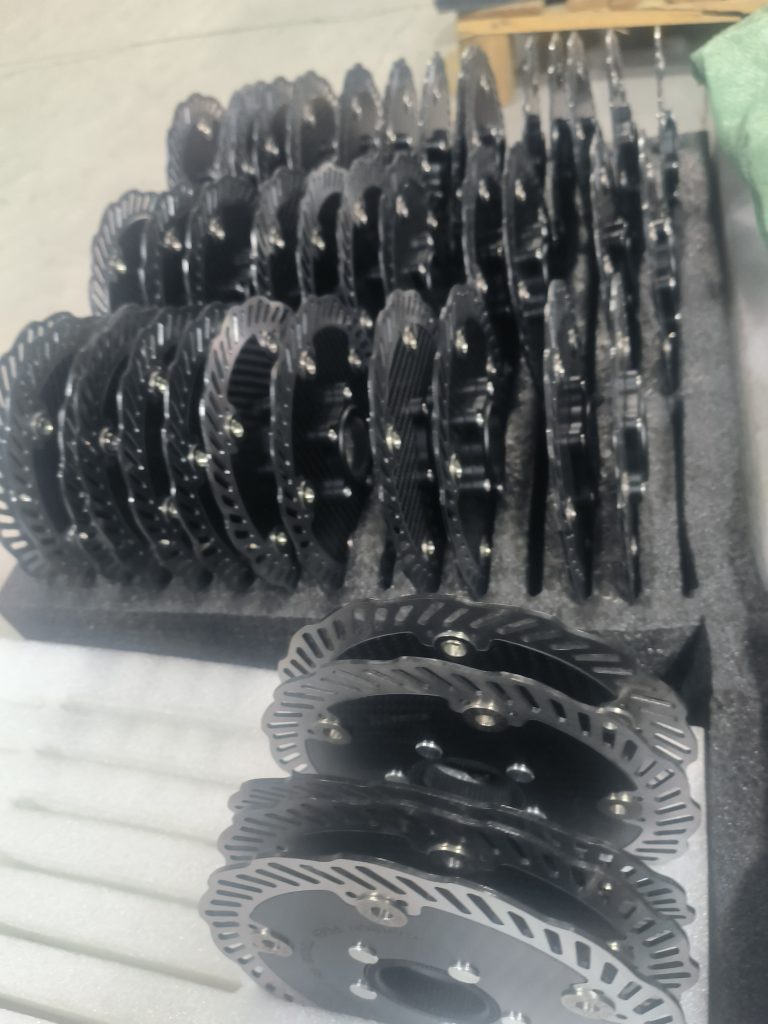
Floating vs One-Piece Bicycle Brake Rotors: A B2B Sourcing Guide
Quick Answer for Buyers
A one-piece rotor uses one main piece for the braking and mounting
structure. A floating, or multi-piece, rotor uses a separate braking
track and carrier joined by hardware. Neither construction should be
selected from the name alone. B2B buyers should compare the intended
bicycle and brake system, mounting interface, confirmed drawing,
inspection requirements, finish, packaging and commercial objective
before requesting a quotation.
What Does “One-Piece Brake
Rotor” Mean?
In a one-piece design, the braking track and mounting section are
formed as one primary component. For sourcing teams, the important point
is not simply that the rotor is “one piece,” but whether the submitted
drawing clearly defines the complete geometry, mounting interface,
identification marks and acceptance requirements.
Questions to clarify include:
- Which drawing or approved reference controls the project?
- Which mounting interface is required?
- Which brake system or bicycle application is the buyer
evaluating? - Which dimensions and tolerances require inspection?
- What finish, marking and packaging information must be
confirmed?
What Does “Floating” or
“Multi-Piece” Mean?
A floating or multi-piece rotor normally separates the braking track
from the carrier and connects the components with dedicated hardware.
The exact design and movement allowed by that connection vary by
product. Buyers should therefore avoid assuming that every rotor
described as “floating” has the same structure or performance.
An RFQ should identify:
- The approved drawing or reference sample.
- The relationship between the braking track, carrier and joining
hardware. - The required mounting interface.
- The dimensions and inspection points that matter to the buyer.
- The expected marking, appearance and packaging presentation.
One-Piece
vs Floating: What Should Procurement Compare?
| Purchasing question | One-piece rotor | Floating or multi-piece rotor |
|---|---|---|
| Construction definition | One primary braking and mounting component | Separate braking track and carrier joined by hardware |
| Drawing package | Complete geometry and inspection points | Geometry plus interface details between components and hardware |
| Supplier review | Manufacturing feasibility, dimensions, finish and marking | Manufacturing feasibility plus assembly relationship and component control |
| Inspection plan | Dimensions, mounting features, appearance and other agreed points |
Component dimensions, assembly relationship, mounting features, appearance and other agreed points |
| RFQ clarity | State the exact design rather than only “one-piece” | State the exact construction rather than only “floating” |
This comparison is a sourcing framework, not a performance ranking.
The correct choice depends on the buyer’s confirmed technical and
commercial requirements.
For diameter and mounting-interface preparation, also read the Bicycle Brake Rotor Diameter and Mounting Interface Guide.
Drawing and
Specification Inputs to Prepare
Before requesting a quotation, prepare the clearest available
technical package. Depending on the project, this may include:
- STEP, DXF or PDF drawings.
- Product photos or an approved reference sample.
- Mounting-interface information.
- Critical dimensions and inspection points.
- Required identification, logo or packaging artwork.
- Destination country and expected order quantity.
- Notes describing the target bicycle or brake-system reference.
If the design is still under review, mark uncertain fields as “to be
confirmed” instead of presenting assumptions as fixed requirements.
Compatibility
Should Be Confirmed, Not Assumed
Rotor construction alone does not establish compatibility. The buyer
should confirm the mounting interface, required geometry, brake-system
reference and any project-specific constraints before approving a sample
or bulk order.
When an existing product is used as a reference, provide clear photos
and identify which features must be matched. When a drawing controls the
project, confirm the latest revision and avoid mixing dimensions from
different versions.
Quality and
Inspection Questions for the RFQ
A useful RFQ explains which characteristics the buyer expects to be
reviewed. The inspection plan should follow the approved drawing and
written agreement rather than generic claims.
Possible discussion points include:
- Incoming component or material identification required by the
project. - Critical dimensions and mounting features.
- Flatness, runout or other geometry checks when specified.
- Assembly relationship for a multi-piece design.
- Surface appearance, marking and workmanship.
- Packaging condition and quantity verification.
- Sample approval records and drawing-revision control.
The exact test method, tolerance and acceptance limit should be
confirmed for the specific project.
Packaging and
Identification for Bulk Orders
Packaging is part of the product specification for distributors and
bicycle brands. Include the requested protection method, label
information, carton markings, packing quantity and any approved artwork
in the RFQ.
For multi-piece rotors, also clarify whether packaging must protect
exposed hardware or finished surfaces. For any construction, the
supplier and buyer should confirm how part numbers and drawing revisions
will be identified.
Which Construction
Should a Buyer Request?
Choose the construction that matches the approved product concept,
technical package, compatibility review, inspection plan and commercial
objective. If those inputs are incomplete, request a technical review
before asking for a final quotation.
A productive supplier discussion should answer three questions:
- Is the requested construction clearly defined?
- Can the supplier review the drawing, reference and inspection
points? - Can both parties record the approved specification before bulk-order
discussion?
RFQ Checklist
Include the following information where available:
- Company name and contact details.
- One-piece or floating/multi-piece construction.
- Drawing, product photo or reference sample.
- Mounting interface and application reference.
- Critical dimensions or inspection points.
- Finish, logo, label and packaging requirements.
- Expected quantity and destination country.
- Sample or trial-order objective.
- Items that remain to be confirmed.
For a broader preparation list, read the Brake
Rotor RFQ Checklist.
Frequently Asked Questions
Is every
multi-piece rotor a floating rotor?
Not necessarily. Product terminology varies, so the construction,
joining method and intended function should be confirmed from the
drawing or approved reference rather than from the product name
alone.
Is a floating
rotor always the better choice?
No universal conclusion should be made from construction alone. The
buyer should compare the approved design, compatibility, inspection
requirements, packaging and commercial objective.
What should
a buyer send for a custom rotor review?
Send the clearest available drawing, product photos or reference
sample, mounting-interface information, expected quantity, destination
and the critical points the buyer wants reviewed.
Can QUNKE quote from a photo
only?
A photo can help start the discussion, but a reliable technical and
commercial review normally requires enough information to identify the
construction, interface, dimensions and project requirements. Missing
fields should be clarified before final confirmation.
When should a
sample or trial order be discussed?
Discuss it after the key technical inputs have been reviewed. The
sample scope, quantity and commercial terms should be confirmed for the
actual project before proceeding.
Related QUNKE Resources
- Bicycle
Brake Rotors - Factory
Capability - Quality
Control - OEM / ODM
- Sample
& Trial Order - Contact /
RFQ
Request a Technical Review
If your team is comparing one-piece and floating bicycle brake rotor
designs, send the available drawing, reference images,
mounting-interface information, expected quantity and destination
through the QUNKE
Contact / RFQ page. Fields that are not yet confirmed can be clearly
marked for discussion.